Posts

FSAE Suspension Force Calculator

Image
For the 2024-25 FSAE season, I developed a MATLAB suspension analysis tool to calculate suspension member loads from simulated contact patch forces. The script reconstructs the suspension geometry from OptimumK kinematics data, solves the suspension kinematics through trilateration, and computes the axial force in each suspension member by enforcing 3D static equilibrium. The tool imports Excel files in the same output format from Optimum Kinematics, a suspension analysis program used by the team’s Vehicle Dynamics group to design suspension geometry. This Excel file is a formatted list of each inboard and outboard suspension point, which is used to calculate the length of each member for trilateration. The user can input a range and step size for steering and shock movement, and each load case from the contact patch force spreadsheet will be evaluated at each suspension position.  T he tool also imports multi-case contact patch loads from Excel, in the ...
Real-Time Python Data Visualization

Image
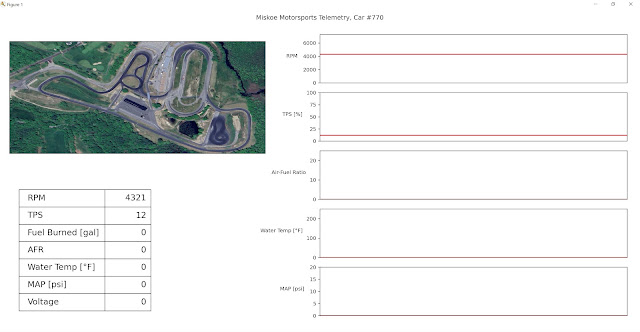
This project is the PC software that goes to this project, a racecar telemetry system. The goal is to take data from the PC/laptop's COM port and display it in real time for viewing in the pit lane at an endurance race. I considered doing this project in MATLAB as it is good at handling arrays of data like what this project requires, and I am more capable in MATLAB than in Python. I chose to use Python so that I could learn more about it and so I could use the program on any computer without needing a license. This project taught me mainly about Python and Object-Oriented programming.  Visualization window produced (car not connected) To start, I knew that I wanted to have a rolling graph of the last ~30 seconds of data received as well as a table with other values that need not be graphed. Like mentioned in the hardware part of the project, displaying the car's fuel consumption is the main goal with added benefit from also displaying other car variables as well.  The car cur...

FSAE Anti-Roll Bar Flexure

Image
This year I am a suspension engineer for RIT's FSAE team, where I designed and installed subassemblies of the suspension system, including the front anti-roll. The main tradeoffs in this design were clearance, weight, adjustability/serviceability, and manufacturing. The previous year's car had a front anti-roll which was difficult to adjust (softer or stiffer) so adjustability was a large focus of the design.  The main things I learned from this project includes strengths of materials, vehicle dynamics, and FEA using ANSYS.  Complete system installed on the car The anti-roll's purpose is to provide resistance to the car rolling (tipping side to side) while cornering, to maintain a mostly even load distribution between each side of the car. In the front, I opted for a Z-bar type design because of its compactness and ease of adjustability. Working with the teams' vehicle dynamics group, I determined the required bar stiffness to achieve a specific roll stiffn...

Racecar Telemetry System

Image
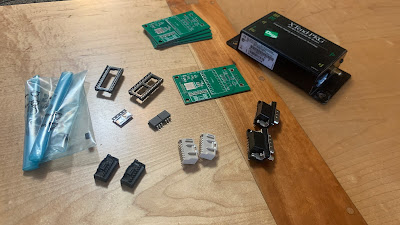
The goal of this project is to collect operating data from a racecar and transmit it wirelessly to the pitlane for real-time review. The most important information to collect is the car's fuel consumption, as the system is used in endurance racing. This project consists mainly of making a PCB which collects car data and sends it to a 900MHz band radio. From this project I made my first PCB and learned about digital communication like CAN and UART. Unpopulated boards, board components, and radio Two populated boards For context on this project, my family has a 1994 Miata modified to do amateur endurance races between 7 and 24 hours in length. It is extremely useful to know how much fuel the car has left in it, and we can do that by knowing how much fuel the car starts each stint with and its fuel consumption through the stint. The car will run for about two hours on a single tank. Racing at Summit Point Raceway in 2023 I started this project with two radios, Digi XTend PKG...